
Prime minister Narendra Modi, speaking at a meeting in Kerala, said that the country needs to become less dependent on imported energy, reported Bloomberg. Modi added that India’s push to develop renewable energy and electric vehicles would cut its fuel needs. The prime minister stressed that India had “taken steps over the years to achieve” more energy independence, citing India’s increased solar power capacity.
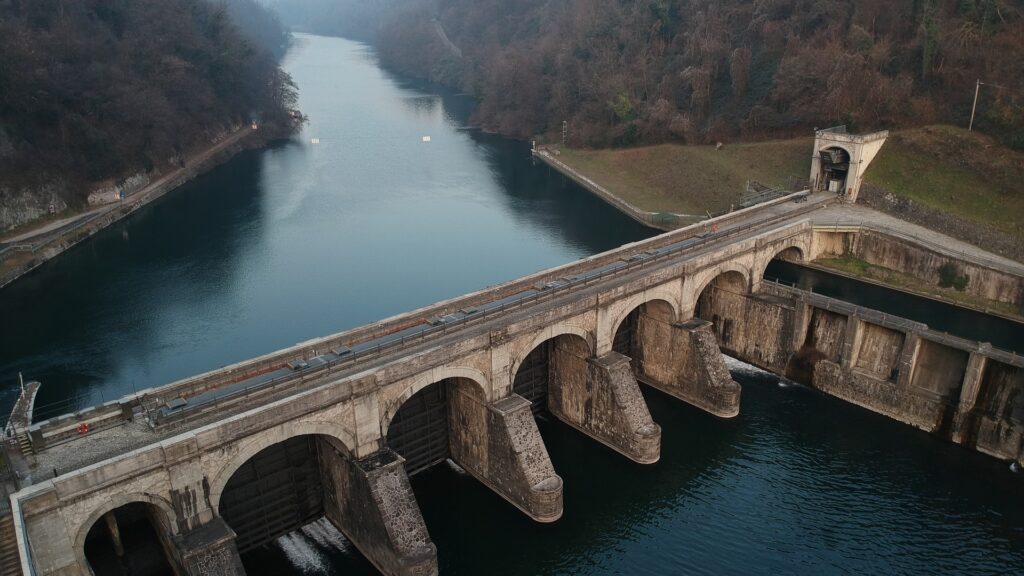
Centre identifying sites in J&K for new hydropower projects, says Power minister
India’s Union Power minister said the government is identifying sites in Jammu and Kashmir to set up new hydropower plants in the region, TOI reported. The minister said some plants are already functional and at others desilting of reservoirs is being carried out.
The minister said the Centre is also studying financial viability and possibility of diverting water from the region towards Punjab, Rajasthan, UP, Haryana through canals.
Ghaziabad mandates Rooftop Solar in New Residential Building Plans
Ghaziabad authorities mandated new measures, which include rooftop solar installations and rainwater harvesting, in new residential buildings. Once approved the sustainability measures will have to be included in the building during the construction phase, ET reported.
The aim is to improve renewable energy and water conservation in districts, the report said.
China’s five-year plan downplays solar after rapid deployment
China has “downplay[ed]” the development of solar energy in the draft of its 15th “five-year plan”, with no specific target for solar installations by 2030 and only “few and far between” mentions of the industry, reported Bloomberg. The report said, instead, the country focuses more on other initiatives that support energy transition, while setting the goal of “doubling offshore wind power capacity” and targets for nuclear and pumped hydro. The “absence” of solar energy does not signify a “rejection”, but rather signals a “strategic shift”,
The country has set an ambitious target of over 100 GW of new installed capacity of pumped storage hydropower, reaching 100 GW total capacity of offshore wind, and increasing interprovincial connectivity to facilitate the transfer of 420 GW clean energy by 2030, CarbonCopy reported.
Eastman starts production at 800 MW solar module facility in Sonipat
Eastman Auto & Power operationalised an 800 MW solar PV module manufacturing facility in Sonipat, Haryana, PV Magazine reported. The company said all solar modules manufactured at the Sonipat facility are fully compliant with domestic content requirement (DCR) norms and standards set by the Ministry of New and Renewable Energy (MNRE), ensuring eligibility for government-supported solar programmes. “By combining high-quality solar manufacturing with advanced energy storage systems, we aim to provide energy solutions that enable faster rooftop solar adoption under initiatives like PM Surya Ghar Muft Bijli Yojana and create long-term value for customers and the clean energy ecosystem.”
China commissions first urban underground vanadium flow battery system
China launched its first urban underground VFB system, a 1.25 MW installation in a commercial building basement to address space and safety constraints that limit lithium-ion and sodium-ion batteries in dense urban areas. It aims to cater to the growing demand for energy storage in places where safety regulations and space constraints limit the use of conventional battery technologies, PV Magazine reported.
The system is designed to support a 1.1 MW air-conditioning load, ensuring a stable power supply during periods of peak demand and grid restrictions. By charging during low-cost off-peak hours and discharging during daytime peak periods, the system helps reduce electricity costs, while maintaining uninterrupted cooling during summer power shortages, the outlet said.
Indian Manufacturing, Solar Modules Face US probe into ‘excess production”
The United States initiated a section 301 probe against India and some other countries to examine structural excess capacity and production in manufacturing. The aim is to know if countries’ policies or practices are contributing to structural overcapacity in manufacturing sectors that could distort global markets and harm U.S. commerce, Mercom reported. Section 301 probes can lead to trade measures such as tariffs or other restrictions, the outlet said.
The US illustrative list of sectors plagued by excess capacity and production includes solar modules, batteries, energy goods, and semiconductors.
According to the US agency USTR manufacturers produce more goods than domestic markets can absorb, leading to increased exports that can depress global prices and affect competing industries.
Solar “mini-grid” success depends on reliability and the capacity for long-term governance: Study
New research on solar mini grids set in Colombian Island communities have found that declining reliability, high operating costs, and limited technical capacity undermined their performance, Science Direct reported. As reliability declined, communities adapted through private diesel generators and informal electricity-sharing networks, increasing costs and reinforcing inequalities. The paper called it adaptation to broken mitigation: when renewable energy interventions designed to reduce fossil fuel dependence fail to deliver reliable service, communities reorganize socially and economically to cope with persistent energy insecurity. The findings demonstrate that electrification alone cannot achieve objectives. Sustainable mini-grid transitions require reliable system design, long-term governance capacity, and coordinated investments in social infrastructure.
About The Author

You may also like
US slaps 126% tariff on solar firms, cites Adani not joining subsidy prob
India installs record 36.6 GW solar in 2025, 81% of the total solar capacity additions from Large projects
US pulling out of ISA throws spanner in works for ties with India
Clean Energy Growth Cuts India’s Coal Power Generation by 3% in 2025: Report
Non-Fossil Fuels Generates One-Third of India’s Electricity in 2025