

From US expansionism to green trade barriers, the forces shaping the year reveal why climate outcomes are diverging sharply



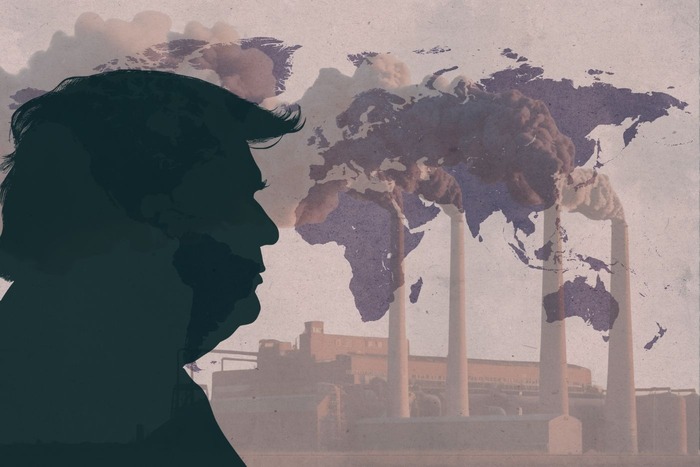
rump’s threat is one more reminder that the world has changed. Visual: Paridhi Choudhary
Climate action in a fractured world: Trends for 2026
From US expansionism to green trade barriers, the forces shaping the year reveal why climate outcomes are diverging sharply
On January 13, US President Donald Trump slapped a 25% tariff on any country doing business with Iran. The news was received with consternation in Iran and beyond. Oil is Teheran’s biggest export — with China accounting for 80% of Iran’s petroleum exports. If the middle kingdom fell in line with Trump’s demands, such an embargo would choke Iran’s oil revenues and its capacity to pay for critical imports. If China didn’t fall in line, the delicate detente between the USA and China on trade might be toast.
Other countries exporting to Iran might need to disengage as well — with hard implications for both Iran and them. Iran imports critical commodities like rice and medicines. Some of its trading partners are delicately placed as well. Exports growth, for instance, is a key part of Sri Lanka’s efforts to ensure economic stability.
With any luck, none of these dire scenarios will materialise. “The US Supreme Court is expected to rule as early as this week on the legality of Trump’s use of the International Emergency Economic Powers Act (IEEPA) to levy tariffs,” wrote Bloomberg columnist Menaka Doshi. It is likely, she said, the court will disallow them.
For now, though, Trump’s threat is one more reminder that the world has changed.
Earlier this month, as the US’ capture of Venezuelan president Nicolas Maduro showed, the world is also slipping back to a Cold War-like division of regions between today’s superpowers — USA, China and Russia. The rot, however, runs deeper. Across the world, as democracies decline, the world is also seeing more naked resource-grabs by the economic and political elite in country after country.
These processes are playing out at a time when ecosystems across our planet have slipped deeper into trouble. Carbon dioxide concentrations hit a record high in 2025. The planet neared the 1.5 Celsius warming threshold, causing extreme heatwaves, floods, droughts and wildlife globally. Biodiversity loss, of course, continued unabated.
Since 1997, when the Kyoto Protocol was signed, the world has been trying to arrest climate change. It was a hopeful time. The cold war had ended. Countries could imagine implementing joint responses to planetary crises.
Today, as the world fragments again, what lies in store for global biodiversity and the world’s fight against climate change? The answer to that question, as team CarbonCopy concluded, lies in how the tussle between six emergent processes — some good, some bad — plays out.
Will superpowers succeed in dividing the world between themselves?
The first (new) variable in the global fight against climate change is the US’ newfound expansionism under Trump. In 2025, we saw signs of this in the critical minerals deal he forced upon Ukraine and his demands seeking Greenland. In 2026, these have been followed by the capture of (now former) Venezuelan President Nicolás Maduro and an announcement that Venezuela will supply 30 million-50 million barrels of oil to the USA each year.
Much of this calls colonialism and the cold war to mind. Back then, too, powerful nations had carved the world between them, using satellite countries for raw materials and/or using them as markets.
“(Trump’s) deployment of US military might to seize Venezuelan oil smacks not so much of a lurch to the future as a return to a past,” the Financial Times noted. “For hundreds of years, the world was divided into spheres of influence when competition over resources — from spices to gold and from rubber to oil — led to the colonisation of nations.” It is only in the post-war period that international law and global trade rules have held a tenuous sway. Now that order appears to be breaking down and reverting to a former age.”
What will such a world look like? Going by Trump’s 2025 National Security Strategy, the USA will focus on western hemisphere dominance, tying access to cheap and abundant energy resources to US’ economic power, jobs and technological dominance. China’s decision last year to restrict rare earth exports is said to be one trigger for this switch. As for Venezuela, it had been moving closer to BRICS and experimenting with non-dollar oil trade.
There are other questions. Will China and Russia help the world isolate the USA, as economist Joseph Stiglitz suggested, or will they seek to capitalise on this moment and annex Ukraine and Taiwan respectively? Expansionism won’t stop there, naturally. And yet, as Trump’s critical minerals deal with Ukraine shows, there is no obvious way to delineate where one sphere of influence begins and another ends. Expect flashpoints here. And wars, as we know, are highly carbon-intensive.
That is just the start. During colonialism, colonies fought for independence. During the Cold War, freshly decolonised countries came together to form the Non-Aligned Movement.
What will happen this time around? In this schemata, despite the presence of Russia and China, will BRICS, chaired by India this year, have some answers? Will it rethink its reliance on international law, multilateral institutions and diplomatic engagements to preserve strategic autonomy? Alternately, will BRICS nations work closer together — potentially opening the door to a bigger thaw in relations between India, China and Russia?
For now, countries will have to tread carefully. India should remain mindful of being drawn too closely into any binary system — especially one where the US and China emerge as the de facto superpowers and the rest are expected to fall in line, said retired Indian diplomat Manjeev Puri.
Can BRICS keep the climate change momentum going?
As the US embraces fossil fuels and expansionism, the world’s fight on climate change is getting marginalised. Pushed into this new world where they might need to defend Greenland from the USA, NATO and Europe are re-investing in weapons manufacturing. This military buildup, said Lowy Institute, is “drawing on stretched public finances – suggesting a sharp retreat from the EU’s climate ambitions”.
As for the US, it has rejected climate change; scuppered the Inflation Reduction Act; pulled support away from ESG; quit the United Nations Framework Convention on Climate Change (UNFCCC), the Paris Accord and the Intergovernmental Panel on Climate Change (IPCC); and embraced fossil fuels — Trump wants them to power even data centres.
In effect, much of the developed world is decoupling from climate action. With that, as COP29 AND COP30 have shown, funds for adaptation and mitigation have been hard to raise. Spigots financing climate change activism are drying up as well. In the past year, major banks and asset managers have retreated from headline climate alliances, not by abandoning climate altogether, but by dropping the language while keeping selective investments alive. Donors are either giving up on climate change as a lost cause — or chasing better returns in energy and elsewhere. Within the Global South, climate activists and environmentalists continue to get persecuted.
Against this backdrop, what will 2026 mean for the global fight against climate change?
One part of the answer again comes back to BRICS. It now houses more than 45% of the world’s population and nearly 30% of global GDP. As a platform for countries where climate change is already an emergency, can it use its collective muscle to keep developed countries active within the multilateral framework for fighting climate change? Or, as superpowers embrace expansionism, will smaller countries, too, invest in defence — leaving smaller allocations for decarbonisation, adaptation and mitigation?
The world is veering away from multilateral climate action to bilateral approaches. Are these a solution?
On January 1, 2026, the EU’s Carbon Border Adjustment Mechanism (CBAM) came into force. Slapping a levy on steel, etc, produced using fossil fuels, it seeks to protect green EU steelmakers from cheaper (more polluting) competition from other countries, while encouraging cleaner manufacturing beyond EU borders. As multilateral efforts falter, such bilateral measures have been hailed as a form of climate progress. Do they work?
Late last year, CarbonCopy had studied the ground-level effects of another ‘green’ trade barrier — Sustainable Palm Oil. Under the 2023 EU Deforestation Regulation (EUDR), anything not forest-friendly will lose access to the EU market. In addition, Oil Palm growers, too, have rolled out initiatives like Roundtable on Sustainable Palm Oil (RSPO); Malaysia Sustainable Palm Oil (MSPO) and Indonesia Sustainable Palm Oil (ISPO). Are these curbing deforestation?
The short answer to that question is ‘No’. A March 2025 study published in Nature found that sustainability pushes like RSPO have reduced efficiency at Malaysia’s palm oil plantations. And so, the market for palm oil has split into two. “When a region — as opposed to all countries — adopts a green measure, what the world gets is a readjustment of trade,” we wrote. “Sustainable palm oil is moving to Europe. Palm oil from Papua New Guinea and elsewhere… is flowing to countries like China and India… For this reason, EUDR is more effective as a trade barrier than an anti-deforestation measure.”
Decarbonisation will continue. It will, however, make differential progress. The US and countries allied to it will lag behind China.
Even as these trends roil the world, renewable energy continues to get cheaper. In 2024, solar photovoltaics were 41% cheaper than their nearest fossil fuel alternative. At 53%, onshore wind projects were even cheaper. As energy storage projects — like BESS or Pumped Storage — added scale, old concerns about the unpredictability of renewable energy are easing as well.
In India, battery storage costs have fallen by almost 80% in the past two years — from ₹10.18 in 2022–23 to ₹2.1 per unit in December. Needless to say, this is a global trend. “The average pack price for stationary storage systems dropped to $70/kWh, 45% lower than in 2024,” reported Bloomberg. Customers are taking note. As old concerns like ‘range anxiety’ eased as well, EVs accounted for more than 20% of all cars sold in 2025.
In effect, the impetus for decarbonisation of energy systems is shifting from governments to markets. In 2025 decarbonisation progressed unevenly across the world. Riding on cheap panels from China, countries like Pakistan beefed up their RE infrastructure. On the other hand, as the Trump administration removed tax credits for green energy and pushed nuclear energy and fossil fuels, “the United States is forecast to add a lot less power from renewables in the coming years than analysts previously expected,” noted NPR.
The implications of US’ actions run deep.
OPEC is in trouble
In addition, (Organization of the Petroleum Exporting Countries) OPEC will slip into trouble. This is not about Venezuela. In the days after the US attack on Venezuela, it was speculated that oil prices will fall as Venezuelan supply enters the market. It has since been argued that Venezuela’s oil reserves are smaller than claimed and that, in addition, the country cannot boost production swiftly. It also emerged that Venezuela’s oil production is a fraction of global production.
In December, for instance, OPEC pegged production in 2026 at 43 million bpd (barrels per day), saying this would closely match global demand. To put that number in perspective, Venezuela currently produces 1.1 million bpd and analysts see its production rising, at most, to 2 million barrels by 2030. To return to its glory days of 3 million bpd in the late 1990s, Venezuela will need to invest as much as $183 billion.
This is where complexity enters the picture. As the share of EVs rises, oil demand will fall. The International Energy Agency (IEA) has already said global oil demand will stand at 40 million bpd, not 43 million bpd. Oil prices should stay under pressure.
As economic elite in each country entrench themselves further, political instability is rising
As country after country sees a rise in inequality, democratic decay and environmental carnage, both precarity and popular discontent have grown. In 2022, the Rajapaksas had to flee Sri Lanka. In 2024, Sheikh Hasina fled Bangladesh. In 2025, popular protests similarly felled the government in Nepal.
This trend is likely to continue in 2026, said economist Jayati Ghosh. “(One) thing I would add is likely greater political instability in a whole range of countries, led by frustrated and angry youth, and geopolitical ramifications of this, which will also affect climate policy.”
As economist Adam Tooze showed in his book ‘Crashed: How a Decade of Financial Crises Changed the World’, one reason for the global surge in right-wing parties was global precarity triggered by the US subprime crisis. In Europe too, popular disenchantment has seen the resurgence of far-right parties. Several of these oppose climate action.
This time around, one trigger for rising precarity – and ergo, unrest – worldover is Trump’s tariff war. How it plays out world over will need to be watched.
Endgame
2025 was not a good year for the Earth.
It had, among other egregious developments, Indonesia calling in the army to clear three million hectares of forests in Papua New Guinea. It was also the third-hottest year in recorded history — this despite the year seeing, as Bloomberg wrote, “a cooling phase in the equatorial Pacific Ocean, or La Nina, that suppresses global temperatures”.
In 2025, scientists reported that humanity has breached seven of the nine planetary boundaries — including climate change and ocean acidification — pushing the Earth’s life‑support systems into dangerous uncharted territory.
In effect, as scientists found, the pace of global warming is accelerating. So much so that the world might surpass the 1.5°C target as soon as 2029, 13 years sooner than projected by the Paris Agreement, and see a year above 2°C of warming by 2029. At that time, expect bigger storms, heatwaves and wild fires. On the brighter side, RE prices continue to fall — and the world continues to decarbonise. Now to see if the Global South can rise to the occasion.

IMD said it is too early to say with certainty during which month El Nino. Photo: Wikimedia Commons
Forecast warns of chances of El Nino onset this year
Early forecasts suggest El Nino conditions may emerge in July-August-September this year. This has raised concerns among meteorologists and climate scientists as El Nino years are associated with weak monsoon and very harsh summers in India, reported the HT. India Meteorological Department said it is too early to say with certainty during which month El Nino will emerge. The National Oceanic and Atmospheric Administration’s El Nino Southern Oscillation (ENSO) bulletin issued on December 29 suggests that there is a 48% chance of El Nino emerging in the second half of monsoon; a 45% of ENSO neutral conditions and a less than 10% probability of La Nina conditions during those months.
2025 was India’s eight warmest year, 2015-25 warmest decade on record
The India Meteorological Department (IMD) said 2025 was the country’s eight-warmest year, with the annual mean land surface air temperature touching 0.28°C above the 1991-2020 long-term average, underlining the persistent warming trend even in years without strong El Nino influence. The country experienced mostly ENSO neutral and La Nina conditions last year, which typically do not drive the kind of warming seen during El Nino years, reported the HT.
The warmest year on record remains 2024, when temperatures soared 0.65°C above the long-term average. The five warmest years for India are 2024 (+0.65°C), 2016 (+0.54°C), 2009 (+0.40°C), 2010 (+0.39°C) and 2017 (+0.38°C). Significantly, 10 of the 15 warmest years have occurred in the past 15 years, with the decade 2016–2025 emerging as the warmest on record.
IMD scientists emphasised that climate change impacts are clearly visible in India’s temperature trends. Over the longer period from 1901 to 2025, the country-averaged annual mean temperature shows a statistically significant warming trend of 0.68°C per century. During this period, maximum temperatures increased at 0.89°C per century while minimum temperatures rose at 0.47°C per century.
The newspaper pointed out that the year also witnessed four cyclones over the North Indian Ocean—two severe cyclonic storms (Shakthi and Montha) and two cyclonic storms (Senyar and Ditwah). Ditwah devastated Sri Lanka after making landfall along the island’s eastern coast in the early hours of November 28, triggering torrential rainfall, widespread flooding and landslides. The cyclone affected over 1.4 million people from more than 407,594 families across all 25 districts, with 410 confirmed deaths and 336 people.
Veteran ecologist Madhav Gadgil passes away
Madhav Gadgil (83), renowned ecologist known for his seminal work on the Western Ghats and a bottom up approach to environmental conservation passed away in Pune last week after a brief illness.
HT reported that Gadgil shaped grassroots environmentalism in India. “He is also known for correctly warning that building infrastructure and development projects in the Western Ghats would lead to disastrous consequences. Gadgil’s landmark work, dubbed the Gadgil Report, called for the protection of India’s ecologically fragile Western Ghats mountain range in the face of growing threats from industry and the climate crisis,” the outlet said.
The newspaper added that written in 2011, the report, whose recommendations are yet to be implemented, was prescient about the fallout of the ravaging of the mountain range.
Gadgil was named one of the six ‘Champions of the Earth’ for 2024 by the United Nations Environment Programme (UNEP). “In a scientific career that has spanned six decades – taking him from the halls of Harvard University to the upper echelons of India’s government – Gadgil has always considered himself a “people’s scientist,” the UNEP statement had said.
Low cost cooling solutions reduce temperatures by 1.24°C in Bihar slums
New case studies published by Nature have revealed how two communities in Bihar living in informal settlements are using quick and low-cost cooling solutions such as radiant foils (that lower indoor temperatures by 1.24°C) and Mylar blankets, which reduce temperatures by .97°C.
Radiant foils consist of double-layered aluminium foil with insulating air bubble core whereas Mylar blankets use aluminised polyester film. Both solutions work primarily by reflecting solar radiation away from roof surfaces.
An additional 62-99 million people could face poverty by 2030 because of climate change
According to a research published by Nature, datasets of subnational poverty in 130 countries covering the past decade found that a 1 °C increase in temperature causes headcount poverty increases of 0.63–1.18 percentage points, using the daily poverty lines of US$2.15 (corresponding to 8.3% and 15.6% increases), and increases in the Gini inequality index of 1.3–1.9%. These poverty estimates equal a projected increase of global poor by 62.3–98.7 million people by 2030 compared with a scenario without climate change. Poorer countries—particularly those in Sub-Saharan Africa—are more vulnerable, as are countries with higher agriculture shares in the economy.
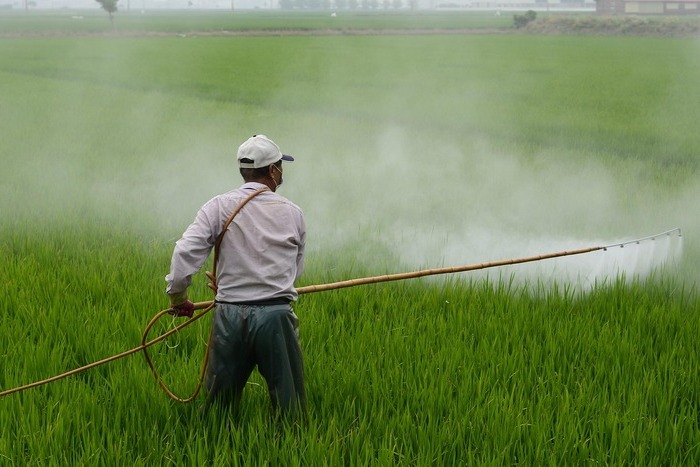
The draft bill 2025 said it aims to “strive to minimise risk to human beings, animals, living organisms other than pests, and the environment. Photo: Pixabay
Pesticides Management Bill, 2025: Revised draft, but old gaps remain
The Centre released a fresh draft of The Pesticide Management Bill, 2025, aimed at regulating manufacture, import, sale and use of pesticides, DTE reported adding that the proposed law seeks to replace the Insecticides Act of 1968 and the Insecticides Rules but the draft introduces limited substantive changes and many of the concerns raised by experts and civil society groups over the earlier version, particularly around regulatory clarity, enforcement powers and accountability, remain largely unaddressed.
While the number of clauses in the bill has been reduced from 65 to 55, the DTE report said the language of the revised draft was weaker.
The draft bill 2025 said it aims to “strive to minimise risk to human beings, animals, living organisms other than pests, and the environment”, instead of a stronger language of “minimise risk”, as suggested and demanded by organisations like Pesticide Action Network (PAN) India in the 2020 version of the draft, the outlet said.
The bill, the Union government said, was a “farmer-centric legislation”, which incorporates provisions such as transparency and traceability to ensure better services to farmers, thereby “promoting ease of living”.
The revised bill, state governments have not been provided with regulatory powers to act on prohibition of pesticides. Under the bill, the state governments can issue a notification to prohibit the distribution, sale or use of a pesticide or a specified batch in such an area for a period not exceeding one year.
Centre allows private, state entities to lease forest land for afforestation without paying mandatory green compensation fee
The Centre allowed private and government entities to lease forest land for afforestation and timber projects without paying mandatory environmental compensation fees, marking a significant shift in India’s forest conservation policy, reported the HT.
The Centre informed states in a letter that afforestation and silvicultural activities — the practice of controlling forest growth and quality — undertaken under approved state plans will now be classified as “forestry activities,” the outlet said.
The newspaper pointed out that the new classification will exempt these projects from compensatory afforestation requirements and net present value (NPV) fees. These are significant financial mandates typically charged to developers to offset the loss of forest land and ecosystem services, the report said.
The directive amends sub-paragraph 14 of paragraph 7.2 of the guidelines notified on November 29, 2023. Under those prior rules, commercial plantations of low rotation or medicinal plants on forest land were designated as “non-forestry activities.” As such, they required specific central government approval based on the merits of each case, as well as the full payment of environmental compensation fees.
Microsoft project in Greater Noida faces action over unauthorised groundwater extraction
The Uttar Pradesh government served a notice to a Microsoft project in Greater Noida over alleged unauthorised groundwater extraction, DTE reported.
Inspectors found 10 borewells operating without mandatory permits, officials told DTE. the outlet said the action comes as Noida and Greater Noida face severe groundwater stress and are classified as over-exploited
Officials carried out a surprise inspection at the Microsoft project site in Sector 145, Noida. During the inspection, they found 10 borewells installed at the premises. The department said no valid permits or NOCs were produced for these borewells at the time, the outlet explained.
Centre launches BRICS India 2026 Logo, and website
External Affairs Minister Dr. S. Jaishankar unveiled the logo, theme and website of India’s BRICS Chairship 2026 on 13 January 2026 in New Delhi. The BRICS India 2026 Logo symbolises inclusivity, dialogue and shared growth, the government press release said, adding that the theme for India’s BRICS Chairship this year is “Building for Resilience, Innovation, Cooperation and Sustainability”. The BRICS India websitebrics2026.gov.in was also launched.
India’s metal exports face 22% price cut threat as world’s first carbon tax goes live today
The European Union’s Carbon Border Adjustment Mechanism (CBAM) has taken effect, placing a carbon levy on imports of emissions-intensive goods, which will result in Indian exports of steel, aluminium, cement and fertilisers face higher costs, potentially affecting competitiveness, DTE reported.
However, it has provisions for the bloc’s lawmakers to expand the list of items that will bear a levy, Indian Express reported. Think tank Global Trade Research Initiative (GTRI) told the outlet that from January 1 2026, every shipment of Indian steel and aluminium entering the EU will carry a carbon cost and several Indian exporters may have to “cut prices by 15–22 per cent so EU importers can use that margin to pay the CBAM tax”.
Developing countries argue that uniform carbon standards ignore historical responsibility and economic capacity differences. India estimates the levy could add an average tax burden of around 25% on affected exports to the EU, DTE said.
To tackle CBAM, Indian exporters have sought assistance from the government for compliance with CBAM, which will necessitate the use of arc furnaces, a cleaner method for iron production using steel scrap compared to blast furnaces that are commonly used in India, the IE report said. Exporters have also asked the government to seek a carve-out for MSMEs during the ongoing India-EU trade deal negotiations, which are expected to be concluded early this year. However, the EU has said that CBAM is not on the negotiating table as it is not a trade measure, IE explained.
$12 trillion needed for climate mitigation needs in Hindu Kush Himalayas: Report
The Hindu Kush Himalayan (HKH) region requires around $12.065 trillion from 2020 to 2050 for climate mitigation and adaptation, according to a new report by the International Centre for Integrated Mountain Development (ICIMOD), reported HT.
The report said India’s total climate finance need for the 2020 to 2050 period is around $2.685 trillion. The actual flow seen during the 2018 to 2021 period was $80.6 billion. For China, the total needs are around $8.46 trillion.
The outlet explained that globally climate finance flows reached approximately $1.3 trillion annually in 2021/2022, predominantly directed toward mitigation activities in developed and larger emerging economies. In contrast, the HKH region receives significantly lower shares, with multilateral and bilateral climate finance frequently failing to meet committed levels, the report has said.
Theregion is one of the world’s most climate-vulnerable regions, facing growing threats from extreme weather events like glacial lake outburst floods (GLOFs), landslides, droughts, floods, forest fires, and intense monsoons.
Proof of land acquisition not needed for green clearances
The HT reported that owners of non-coal mining projects will no longer have to show proof of land acquisition as a pre-requisite for environmental clearance, according to a recent change made by the Union environment ministry. The outlet said the move is aimed at fast-tracking the approval process for offshore and onshore oil exploration and production, oil and gas transportation pipelines passing through eco-sensitive areas, highway projects, and mining of minerals.
The article explained that until now, the ministry required proof of land acquisition. The report pointed out that in an office memorandum (OM) issued in 2014, it listed documents that could be offered as proof or in lieu of it: preliminary notification issued by the state government regarding acquisition of land as per the Land Acquisition, Rehabilitation and Resettlement Act 2013; and in case of acquisition by private companies, a credible document showing the intent of land owners to sell their land for the proposed project.
Top court stays its own verdict defining Aravali hills and ranges after large-scale protests
The Supreme Court stayed its November 20 judgment upholding a government expert panel definition restricting the world’s oldest surviving mountain systems, the Aravalli, to hills sporting an elevation of 100 metres or above, and hill clusters, slopes and hillocks located within 500 metres of each other.
It directed that no fresh or renewed mining leases should be given without prior permission of the apex court, the Hindu reported.
The move follows concerns that the definition was being misconstrued, DTE reported, adding that protests erupted in Rajasthan and Haryana over fears of mining and ecological damage. The court has ordered the formation of a high-powered, independent expert committee. Mining activity has been halted until the new assessment is completed, the outlet said.
To speed up leases, Centre tells states, UTs to hold just one forest survey before mining
Amid concerns that the Centre’s definition of the Aravalli hills will open the range up for mining, the Union environment ministry ordered states and Union territories to conduct just one survey of forests to be mined, saying “repetitive” surveys caused delays and “unnecessary expenditure”, reported the HT.
The outlet said that in the letter, dated December 11, the ministry said separate surveys by multiple agencies as well as the bidder delayed the execution of mining leases. The news report said experts criticised the move and pointed out that each survey had separate objectives and unique parameters. A joint check, they argued, will not meet these standards, impinge on each department’s autonomy and will water down a crucial process baked into law to safeguard forests and green spaces.
Trump withdraws from key climate treaty, the US becomes the only country to do so
The Trump administration has announced its intention to withdraw the US from the world’s overarching climate treaty, CNN reported. The move to leave the UN Framework Convention on Climate Change (UNFCCC), alongside 65 other international organisations, was announced via a White House memorandum that states these bodies “no longer serve American interests”, adds the news channel. The New York Times said the UNFCCC “counts all of the other nations of the world as members” and describes the move as cementing “US isolation from the rest of the world when it comes to fighting climate change” Associated Press pointed out that the US is exiting, including other climate-related bodies such as the Intergovernmental Panel on Climate Change (IPCC) and the International Renewable Energy Agency (IRENA). Washington Post said this also means the withdrawal of US funding from these bodies.

Indore’s contaminated water has flagged serious negligence by authority, which led to the death of 15 people and over 200 people undergoing treatment. Photo: Wikimedia Commons
CAG Report Found Serious Flaws with Indore’s Contaminated Water, Authorities Remains Unconcerned
Indore’s contaminated water has flagged serious negligence by authority, which led to the death of 15 people and over 200 people undergoing treatment. A news report by Down to Earth revealed that residents of the city have been complaining about this issue for a long time, but the authorities have been alerted only now.
The tragedy occurred due to the mixing of sewage water with the drinking water and citizens reported that the tap water cannot be used for drinking directly without purifying it with alum and chlorine. The CAG report that was published in 2019 about the water management in Bhopal and Indore revealed various deficiencies in the city.
Over past one year, 34 died drinking contaminated tap water across India
Last year (Between January 2025 and January 7, 2026) at least 5,500 people fell ill in 26 cities, including 16 state capitals, across 22 states and Union territories after consuming sewage-contaminated piped drinking water, DTE reported, adding that at least 34 people died.
The report said diarrhoea was the most commonly reported illness, followed by typhoid, hepatitis and prolonged fever, according to media reports and official statements from affected states.
The article noted that in almost every case, contamination was traced to sewage mixing with drinking water — often because ageing, corroded or poorly laid water pipelines run dangerously close to sewer lines. Any leak or drop in pressure allows sewage to seep directly into household connections.
In a majority of cases, decades-old pipelines were identified as the primary cause. Many Indian cities continue to rely on water distribution networks laid more than 40 years ago. In Delhi, for instance, around 18 per cent of water pipes are over 30 years old, according to a report by the Delhi Jal Board. Cracks in these pipes — often laid alongside or below sewer lines — create repeated contamination risks.
NGT Flags Waste Management Gaps in Delhi, Seeks Updates on Yamuna Pollution
The National Green Tribunal (NGT) in its recent hearing flagged solid and liquid waste management gaps, noting that untreated waste continues to accumulate in the sewage and is discharged into Yamuna river, reported Tribune India.
The tribunal said repeated warnings have not translated into sustained action on the ground. The tribunal directed the Chief Secretary to submit a detailed report on sewage generation, treatment, and discharge, and asked the Delhi Pollution Control Committee to provide water quality data.
Secondary Aerosols Responsible for One-Third of Delhi’s Annual PM2.5 Pollution
Secondary aerosols now account for at least a third of the city’s annual PM2.5 pollution. This has intensified exposure during prolonged smog spells and explains why air quality can deteriorate sharply even when local sources seem under control, reported Indian Express.
Secondary particulate matter is formed after gases are released into the air. These gases, known as precursor pollutants, undergo chemical reactions influenced by humidity, temperature and sunlight. They eventually form microscopic particles that penetrate deep into the lungs.
NGT Directs CAQM to Act on Illegal Constructions After Woman Flagged Serious Health Issues of Two-Month Old Daughter
The National Green Tribunal (NGT) has asked the Commission for Air Quality Management in NCR and Adjoining Areas (CAQM) to act against those who are violating the ban on construction in the city, reported The Hindu.
This action came after a woman complained about the serious health issue of her two-month old daughter. The applicant also stated that despite the multiple complaints to the government and the CAQM, no action was taken.

The US' withdrawal from the ISA could make it difficult for the agency to meet its target of raising $1 trillion in solar investments by 2030. Photo: Wikimedia Commons
US pulling out of ISA throws spanner in works for ties with India
The US’ withdrawal from the International Solar Alliance (ISA) could make it difficult for the agency to meet its target of raising $1 trillion in solar investments by 2030, while reducing technology costs and finances, reported ET. It added that this is another move towards dismantling the carefully made three-decade long India-US bilateral relationship.
The ISA was launched by India and France at the 2015 Paris climate summit. The US joined in 2021. The report said John Kerry, the then special climate envoy, described Trump’s move as a “self-inflicted wound” and a “gift to China.”
CEA 2025 review: India’s power shift enters utilisation phase as renewables surge, coal holds energy backbone
India’s electricity system has moved decisively beyond chronic shortages into a more complex phase of managing utilisation, grid stress and industrial self-generation, as rapid renewable energy growth reshapes, not yet replaces, coal’s role, according to the Central Electricity Authority’s (CEA) All India Electricity Statistics-General Review 2025, DTE reported.
The report said India’s installed electricity generation capacity rose to 441.97 gigawatt (GW) as of March 2024, while total power generation crossed 1,734 billion units (BU), signalling a structural shift in the country’s power mix led by clean energy expansion.
India’s installed electricity generation capacity rose to 441.97 gigawatt (GW) as of March 2024, while total power generation crossed 1,734 billion unit (BU), signalling a structural shift in the country’s power mix led by clean energy expansion, the outlet wrote citing the CEA report.
Centre grants extra time for solar projects hit by bird conservation
The Centre granted renewable energy developers extra time to commission projects delayed by a Supreme Court case on power transmission lines in habitats of the endangered Great Indian Bustard, Reuters reported.
The ministry said delays in securing approvals for overhead transmission lines in the bird’s habitat areas in Rajasthan and Gujarat will qualify as “force majeure”, allowing developers to seek extensions to scheduled commissioning dates.
The decision comes after a December 2025 Supreme Court verdict that ended the long-running case and backed an expert panel’s proposal to protect the bird. The panel proposed tighter limits on new wind and large solar projects inside the bird’s habitat zones. It also called for undergrounding key power distribution lines and rerouting high-voltage corridors. The court had earlier curbed overhead lines in bustard habitats, prompting developers to hold back projects while they awaited clearances.
India adds record 37.9 GW of solar capacity in 2025
India installed a record 37.9 GW of solar and 6.3 GW of wind capacity in CY2025 (January–December), marking its highest-ever annual renewable energy additions, PV Magazine reported. Compared to CY2024, solar capacity additions rose by 54.7%, while wind installations increased significantly by 85.3%.
The outlet cited data released by the Ministry of New and Renewable Energy (MNRE), according to which India’s cumulative installed renewable energy (RE) capacity reached 258 GW as of December 31, 2025. Solar energy accounts for approximately 53% of the total RE capacity, making it the largest contributor, followed by wind (21%), large hydro (20%), bio power (4%), and small hydro (2%).
Only 50% of standalone battery energy storage system (BESS) analysed have positive project economics: Mercom
Just about 50% of standalone battery energy storage system (BESS) projects analysed in India demonstrate positive project economics under modeled assumptions, according to Mercom India Research. The projects assessed were auctioned between July and November 2025.
PV Magazine covered the report that examines the current cost landscape for energy storage in India and compares recent auction bidding with underlying project economics.
China extends anti-dumping duties on solar-grade silicon from US, South Korea
China extended anti-dumping duties on solar-grade silicon from the US, South Korea. China’s Ministry of Commerce (MOFCOM) extended the anti-dumping duties it imposed on solar-grade silicon imports from the United States and South Korea in 2014, PV Magazine reported.
The duties range from 53.3% to 57% for US producers and from 2.4% to 48.7% for South Korean companies and will remain in force for a further five years.
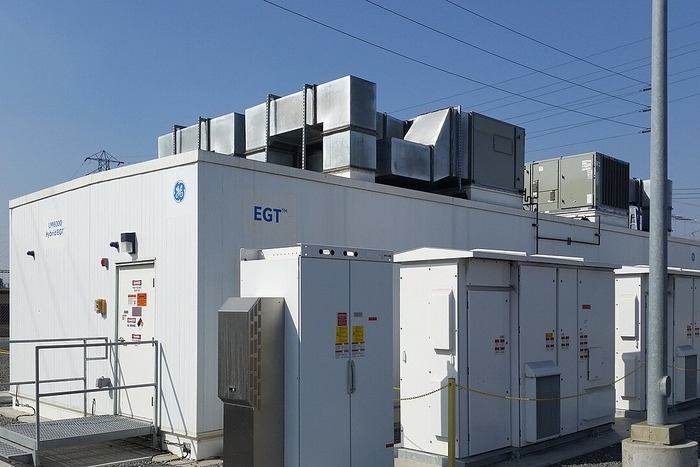
India’s battery capacity will rise almost ten times to 5GWH in 2026. Photo: Wikimedia Commons
India’s Battery Energy Storage to Rise 10 Fold in 2026 Driven by Pipeline Projects
India’s battery capacity will rise almost ten times to 5GWH in 2026 from 507MWH in 2025 driven by major pipeline projects. This year will also be the turning point for the sector as projects that started two years ago will begin to come in stream, reported The Times of India.
The previous year also saw an increase in tender with 62 tenders amounting to 102GWH capacity, which is equal to the amount of tenders between 2018 and 2024 combined.
Electric Cars to Get Pedestrian Warning Sounds from 2026 to Help Avoid Accident Risks
The Road Transport and Highway Ministry mandated electric vehicles (EV) to be equipped with Acoustic Vehicle Alerting System (AVAS) for ‘M’ and ‘N’ electric vehicle categories to address the risk posed by silent engines to pedestrians, reported Hindustan Times.
According to the ministry, the rollout will be in a phased manner, allowing carmakers to integrate the technology into their vehicles with new vehicles complying with the mandate by October 2026, while older vehicles retrofitted by October 2027.
Chandigarh EV Policy Saw a Rise in Registrations and Emission Cuts
Chandigarh’s EV drive has led to a 16-fold rise in electric vehicle (EV) registrations in just five years. This has also led to a sharp 26-fold jump in carbon dioxide emissions savings, reported ETAuto.
The Chandigarh administration introduced the Chandigarh EV Policy in September 2022 that gave a number of financial incentives and benefits to push consumers from fossil fuel based cars to buy EVs.
Cars to Talk to Each Other Soon as Centre Pushes for V2V Safety Technology
The Centre will be introducing vehicle to vehicle (V2V) communication technology in India soon to reduce road accident risk by allowing vehicles to exchange real time safety information, reported Hindustan Times.
Transport and Highway Minister Nitin Gadkari said the technology is underway and they have set up a joint taskforce with the Department of Telecommunications to take the plan forward. Under this technology, vehicles will be able to alert drivers about the speed, location, and other movements of nearby vehicles.This technology will also help identify blind spots, giving drivers advance warnings and more time to respond to potential hazards on the road.
Global Sales of EVs to Slow Down This Year as China Winds Down Subsidies
Global sales growth in EVs is expected to slow down this year as China, Europe wavers on its phase out of combustion engines, and US producers and policymakers make a U-turn from the segment, Bloomberg reported.
According to BloombergNEF, drivers are expected to buy around 24 million passenger EVs in 2026, a 12% increase on 2025, which is lower than 23% growth in sales last year. The US EV market is already struggling as the Trump administration withdraws up to $7,500 consumer tax credits after September and weakens fuel economy standards.
NTPC May Buy a Minority Stake in US Clean Core Thorium Energy
State-owned NTPC is eyeing a minority stake in US Clean Core Thorium Energy while clarifying that no binding agreement has been signed so far, reported ET Energyworld.
This development came after the parliament cleared the Sustainable Harnessing and Advancement of Nuclear Energy for Transforming India (SHANTI) Bill, which opens the nuclear power sector to greater private participation and addresses long-standing concerns around liability and technology transfer.

US President Donald Trump has greenlit a sanctions bill that could impose 500% tariffs on countries buying oil from Russia. Photo: Wikimedia Commons
First in 52 years: Historic fall in coal power simultaneously in China and India
Analysis by Carbon Brief, found that coal power generation fell in China and India last year, “the first time since 1973 that coal use fell in both nations at once”. The Hindustan Times reported that “both countries added record clean-energy capacity” in 2025, while also reducing electricity generation from coal by 3% in India and 1.6% in China. The Guardian pointed out that the “‘historic’ moment…could bring a decline in global emissions”. Bloomberg also covered the report saying “it’s unclear yet whether the drops will mark a broader inflection point, or will end up as blips”. The Indian Express said that, in India: “Apart from the increase in renewable energy generation, relatively milder summer and a decrease in power demand growth due to other reasons also contributed to the dip in coal-fired electricity generation in 2025.”
Trump Approves the 500% Tariff on India, China, Brazil to Deter Them From Buying Russian Oil
US President Donald Trump has greenlit a sanctions bill that could impose 500% tariffs on countries buying oil from Russia. This bill will give him leverage against the countries to stop them from Moscow, reported ETEnergyworld.
Trump has imposed 50% tariffs on India, among the highest in the world, including 25% levies for its purchases of Russian energy.
US’s Venezuela oil plan could exhaust 13% global carbon budget to remain under 1.5°C, Oil Groups seek Legal and Financial Guarantee Before Investing in Venezuela
The US plans for Venezuelan oil could “consume more than a tenth of the world’s remaining carbon budget to limit global heating to 1.5°C” by 2050, according to analysis covered by the Guardian.
US oil groups are pushing President Donald Trump on providing strong legal and financial guarantees before investing in Venezuela, reported Financial Times.
Earlier this month, Trump announced that the American oil companies will be reimbursed by the US or through revenue if they invested in Venezuela. Chevron is the only American company that holds a US license to export Venezuelan crude and is seeking to amend its agreement with the US Treasury department to sell more oil.
Bharat Coking Coal Draws $13 Billion in Bids on Strong Demand from Steelmakers
Bharat Coking Coal Company drew bids worth $1.17 trillion for its $118.7 million initial public offering (IPO) on stronger demand for coking coal from steelmakers, reported Reuters.
India’s top coking coal miner received bids for 50.93 billion shares, nearly 147 times the number of shares on offer.
India Held Talks with US Secretary Rubio on Trade, Critical Minerals, and Nuclear Power
India’s foreign minister S Jaishankar held talks with US Secretary of State Marco Rubio on trade, critical minerals, and nuclear power, reported Reuters.
India has pledged to buy more US energy and defence equipment to help narrow the trade deficit and both the countries have also set a target of doubling bilateral trade to $500 billion by 2030.
Dark Fleets Seek Russian Protection as US Seizes Oil Tankers
Dark fleets around the world are seeking Russian protection after the US started seizing oil tankers with Venezuelan trade, Bloomberg reported.
According to Starboard Maritime Intelligence Data, at least 26 ships have switched registrations to Russia since the beginning of last month. A jump from six in November and just 14 over the previous five months.